
Know your appliance
Valor's emphasis on radiant and natural convective warmth changes how owners should interpret fireplace performance, but it does not remove the need for model-specific maintenance. A quiet appliance without a running fan is operating as intended; an ignition fault or damaged seal still requires qualified attention. This guide uses official Valor information and H3 documentation to explain identification, fuel, venting, controls, HeatShift compatibility and ownership decisions. Vaughan Chimney Services is an independent service business, not an authorized Valor dealer. No factory affiliation is implied, and gas repairs, internal inspection and installation changes must be handled by appropriately qualified personnel.
Identify the Engine Behind the Decorative Front
A Valor's decorative front does not necessarily reveal the exact appliance engine behind it. Start with the complete model designation, serial number and fuel from accessible records or the identification label. The official H3 installation manual, for example, identifies natural-gas model 1000KN and propane model 1000KP. Preserve those complete codes when seeking service or parts. A request describing only an H3, an approximate opening size or a particular trim colour may leave important compatibility questions unanswered.
Valor's official manual library organizes appliance documents alongside trim, liner, remote and accessory information. Gather the relevant pieces rather than relying on a single brochure. The cited H3 manual states that a trim kit is required to complete that installation and that the barrier screen is supplied with the trim kit, illustrating why engine and front documentation both matter. Do not remove sealed glass or unfamiliar components to locate a hidden label. Have a professional document it during service if ordinary owner access is insufficient. Photographs of the full installation, controls and existing paperwork provide useful context without requiring dismantling.
Recognize Quiet Radiant Heating as an Intended Feature
Valor describes its fireplaces as providing radiant warmth and natural convective heating without depending on a noisy fan. This is a verified Valor design theme, not a rule that should be applied indiscriminately to other manufacturers. An owner should therefore avoid diagnosing a fault solely because no blower noise is heard. Identify the installed appliance and any optional accessories, then compare actual behaviour with its instructions. The absence of forced airflow can be normal, while a change in established heat delivery or burner operation still deserves investigation.
Radiant comfort and room-air temperature are not identical observations. Furniture placement, room layout and the fireplace's normal operating setting can influence the experience of warmth. Do not move combustibles closer, remove the barrier or alter burner components in an effort to feel more heat. If the appliance's output is different from previous seasons, record the conditions and request assessment rather than assuming a fan needs repair. Also distinguish manufacturer descriptions of heating capability from a promise to heat every part of a house. Suitability depends on the actual model, installation and space, and should be evaluated accordingly.
Confirm Fuel and Venting Before Interpreting a Problem
The cited H3 documentation identifies a direct-vent gas fireplace with separate natural-gas and propane model codes. That distinction should appear consistently in the appliance label, installation records and parts selection. Do not infer fuel type from flame colour or a previous owner's recollection. Any discrepancy requires qualified verification. Gas pressure checks, conversion questions, burner adjustments and gas-control repairs are professional work. Owners should not experiment with settings or substitute components to determine which fuel arrangement is present.
The vent system must also match the exact engine and approved configuration. Gather the available installation drawings and information about adapters, terminations or other vent components. An existing chimney or exterior cap does not establish that all concealed connections are suitable. From a safe position, note visible damage or changes around the termination, including new construction or vegetation, and report them. Leave disassembly, access at height and verification of concealed routing to appropriately qualified personnel. A fireplace fault should be assessed in the context of its air and exhaust arrangement, not attributed automatically to the handset or burner because those are more visible.
Check HeatShift Approval by Model Generation
HeatShift is not a generic duct arrangement that can be added to any fireplace. Valor's cited H3 HeatShift instructions identify use with 1000K and 1000M heaters only and explicitly exclude Series J. They also specify the LDK8 plenum for that H3 application. This is an unusually clear example of why a familiar product name is not enough: two fireplaces called H3 may belong to generations with different accessory approvals. Establish the complete engine designation before discussing an existing or proposed HeatShift installation.
The same instructions describe natural-convection heat redistribution without a fan and require the HeatShift directions to be used together with the fireplace installation instructions. Do not block discharge outlets, improvise duct changes or assume that reduced mantel clearances apply merely because an outlet is visible above the fireplace. Those allowances depend on the approved system being installed correctly. Owners should not remove internal baffles or alter ducts. A qualified professional must verify the actual configuration and applicable clearances. Keep the accessory manual in the ownership file so future renovations do not unknowingly cover an outlet or change a heat-management arrangement.
Separate Control Confusion From Unsafe Operation
When a Valor does not respond as expected, describe the sequence rather than assigning a cause. Record the handset display, the selected operating mode, whether ignition begins and whether shutdown follows immediately or after a period of operation. Mention recent battery changes, interruptions, service or building work. Consult the manual for the installed control, since a different Valor remote may use a different sequence. Do not repeatedly start the appliance to make a fault recur, especially when ignition is abnormal or the unit has already shut itself down unexpectedly.
Safe owner checks include only ordinary settings and user-accessible battery procedures permitted by the relevant instructions. Do not bridge terminals, bypass safeguards, adjust gas pressure, move logs or remove sealed glass. Stop operation for cracked glass, abnormal ignition, new soot or unresolved repeated shutdown. For gas odour, leave the building immediately without operating switches or using a phone indoors, then call the gas supplier or emergency services from outside. For a carbon-monoxide alarm or suspected exposure, also leave immediately and obtain emergency assistance from outside. Troubleshooting must wait until the emergency has been addressed.
Use Service to Assess Combustion, Controls and Air Paths
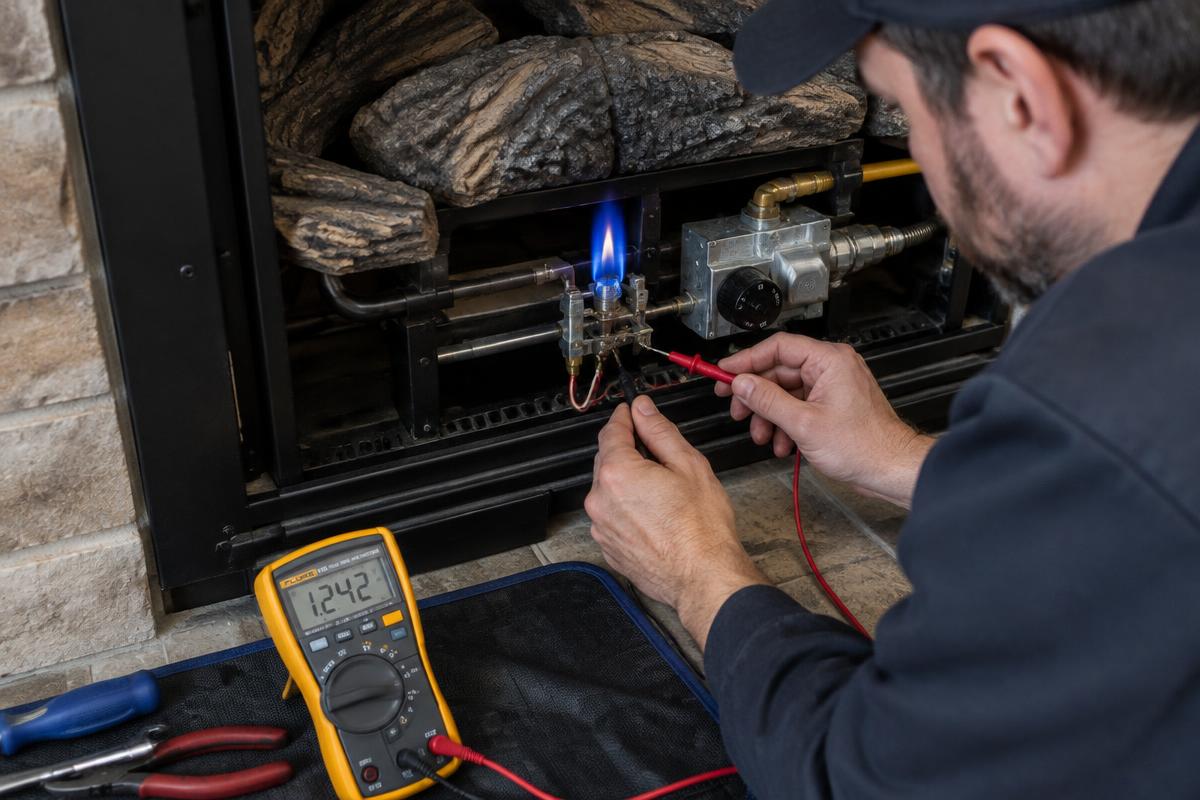
A professional Valor maintenance visit should be tied to the installed engine and accessories. Relevant areas include the burner and ignition system, controls, combustion enclosure, glass and seals, barrier and accessible vent arrangement. If HeatShift or another approved accessory is present, its condition and unobstructed function also need consideration under the correct documentation. Gas-system tests and adjustments belong to appropriately qualified personnel. An inspection should not be reduced to wiping the window and confirming that a flame appears.
Explain any recurring deposit, shutdown or change in heat delivery before cleaning begins. The technician can then consider whether the symptom points to an underlying concern rather than simply removing visible evidence. Ask for written findings distinguishing cleaning performed, tests or checks completed, proposed parts and limitations. The manufacturer guidance and actual operating conditions should determine scheduling. An unknown service history, renovation contamination or abnormal operation can warrant earlier assessment than a household's usual annual routine. If a condition cannot be resolved during the visit, the report should make clear whether continued operation is appropriate or the appliance must remain off.
Keep the Glass Enclosure and Protective Front Correct
Valor's H3 instructions warn about hot glass and require the protective barrier associated with the completed installation. The barrier reduces burn risk; it does not make the viewing area cool to touch. Keep children and vulnerable occupants away, including after shutdown while the appliance cools. A damaged or missing barrier needs the correct replacement. Do not remove it for a clearer view, substitute an improvised screen or assume that a decorative front provides equivalent protection without verifying its approved application.
The glass assembly and seals also need exact compatibility. Stop using the appliance if the glass is cracked, its retaining arrangement is displaced or the enclosure seal is uncertain. Do not fit household glazing, generic gasket material or sealant as an improvised repair. This guide does not instruct homeowners to remove sealed gas glass for cleaning. Qualified personnel should assess and clean the assembly, investigate abnormal deposits and restore it correctly. Photographs taken through the glass can help document a recurring condition without opening the enclosure. A cleaner appearance alone does not establish that the cause of soot or an operational change has been corrected.
Make Every Part Order Traceable to the Installed Appliance
Valor's manual library lists appliance engines, fronts, liners, remote documentation and accessories separately. That organization reinforces the need to verify each part against its intended application. Supply the full engine code, serial number, fuel and relevant accessory designation before ordering. A part that appears under the same broad product family may still have restrictions by generation or configuration. The H3 HeatShift exclusion for Series J demonstrates how significant those restrictions can be even when the marketing name remains familiar.
Ask for the proposed part number and confirmation of any supersession before authorizing replacement. Preserve invoices, packaging identification and the service report afterward. Do not accept improvised gas components, altered safety circuits or unverified glass because a matching original is difficult to source. If earlier work introduced undocumented parts, the professional may need to establish the approved configuration rather than copying what is already fitted. Where compatibility cannot be confirmed, uncertainty should remain visible in the record and the appliance should stay out of service when safe operation depends on the unresolved item. Physical fit is not sufficient proof of suitability.
Prepare for Outages Without Assuming Unlimited Backup Heat
Valor promotes heating that does not depend on mains power or a fan, but owners should still review the exact model's operating provisions before an outage. Confirm the relevant control and battery instructions, resolve existing faults and understand which installed accessories may have separate requirements. Do not assume that a fireplace with an unresponsive control will operate simply because the brand emphasizes power-outage capability. Readiness is an appliance-specific condition, not a guarantee created by a general product description.
Before winter, maintain smoke and carbon-monoxide alarms, clear required spaces and review the last inspection findings. Check accessible termination surroundings after storms without climbing or inserting tools into the vent. Follow the applicable instructions for periods of non-use rather than applying universal advice about leaving pilots on or off. Keep HeatShift outlets and other required openings unobstructed through seasonal decorating and room changes. If water intrusion, renovation dust or a building alteration may have affected the installation, obtain assessment before startup. A fireplace should never be used to dry clothing or warm stored objects placed against its hot surfaces.
Give New Users a Model-Specific Handover
A Valor's quiet operation can make it easy for a new user to misunderstand which functions are active. Provide the instructions for the installed controller and explain the normal owner settings without entering the appliance or altering internal controls. Identify the correct engine and accessory documents, especially when a decorative front or HeatShift arrangement has its own requirements. A family member familiar with another Valor model should not assume the same remote sequence, battery access or shutdown procedure applies.
Keep the latest inspection findings available to everyone who operates the fireplace. If a fault has left the appliance out of use, make that restriction explicit rather than relying on a silent control or a verbal message to one occupant. When the home is sold, pass along the document set and repair history, including any unresolved recommendation. This allows the next owner to separate normal fanless heating from a genuine change in performance. It also gives a new service provider the information needed to assess accessories and compatibility without treating the visible trim as the complete appliance identity.
Choose the Next Step From Condition and Heating Goals
Repair can be sensible when the fireplace and vent are in suitable condition and the identified fault has a verified remedy. Replacement is worth considering when deterioration is extensive, safety-critical parts cannot be confirmed or a major installation correction is required. Ask the professional to distinguish definite findings from possibilities needing further investigation. Also explain your heating goals. A desire for different heat distribution or a new appearance is not the same issue as an unsafe condition, and the options should be compared on that basis.
A replacement assessment must consider the full installation: venting, fuel, clearances, framing, electrical provisions, barriers, heat-management accessories and future service access. Do not assume that a newer Valor will connect to every existing component or inherit the same mantel allowance. Maintain a complete ownership folder with labels, engine and accessory manuals, installation approvals where available, inspection reports and repair records. Vaughan Chimney Services is an independent business, not an authorized Valor dealer or manufacturer representative. Product-specific support and compatibility questions must be resolved through verified official information and appropriately qualified channels, without implying factory authorization or a manufacturer-backed service promise.