
Know your appliance
Heat & Glo fireplaces combine appliance-specific combustion systems with a range of fronts, controls and installation options. That makes accurate identification essential: a remote, a decorative trim package or a familiar linear flame does not tell the whole technical story. This guide helps Vaughan, Ontario, homeowners organize safe observations, understand service boundaries and make informed decisions about maintenance, parts and replacement. It draws on Heat & Glo's official owner resources and model documentation without turning manufacturer service procedures into do-it-yourself gas instructions. Vaughan Chimney Services is an independent business, not an authorized Heat & Glo dealer or partner. Use the manual matching the complete model and production version, and leave technical diagnosis and repairs to appropriately qualified professionals.
Identify the appliance beneath the design
A wide glass opening or a recognizable decorative front is not a complete Heat & Glo identification. Record the exact model, serial number and rated fuel from the appliance rating plate. Include suffixes that distinguish versions or configurations. The MEZZO owner manual, for example, covers several sizes and separate see-through designations; those differences matter when selecting documentation and planning service. Do not substitute a manual simply because its cover shows a similar fireplace.
Heat & Glo provides a manual search for installation instructions, owner's manuals and service-parts information. Start there once the rating information is available. Locate the plate only through the owner-access method appropriate to the model, with the appliance cool. Do not remove sealed gas glass or dismantle a finish wall to search for it. Photograph the whole installation, front and controls as well as the plate. If access is unclear, a service professional can confirm the identity without turning a preliminary check into unplanned disassembly.
Distinguish the firebox, vent and finishing system
A Heat & Glo installation includes more than the visible appliance. Venting, termination, framing, finishing materials, protective front and service access all affect safe operation. Direct-vent gas models use their specified sealed combustion arrangement; other equipment categories must be evaluated from their own documentation. A chimney chase outside the house does not prove that the gas fireplace uses a conventional masonry flue, and a horizontal termination does not reveal all the concealed vent connections.
Do not alter the surrounding design without checking the appliance requirements. A new mantel, television installation, cabinet, wall covering or recessed feature can affect clearances, heat exposure and access. Some product lines have additional heat-management options, but an option advertised for one model is not permission to improvise the same arrangement on another. Before renovation, preserve the existing identification and obtain the applicable installation instructions. Ask the professional to review the proposed finished dimensions rather than relying on general rules taken from a different Heat & Glo showroom display.
Treat fuel changes as a documented technical project
The MEZZO and 6K/8K owner documentation states that the appliance must use the gas identified on its rating plate and requires a certified kit for an allowed conversion. Natural gas and propane are not interchangeable operating choices. A homeowner should not adjust a valve, change an orifice or use an improvised conversion procedure. The correct approval, kit and qualified installation requirements must be established for the exact model.
Keep any conversion record with the appliance manuals and ensure the identification information reflects the completed authorized work as required. If you move into a home and the supply fuel appears inconsistent with the records, leave the appliance unused until the discrepancy is resolved. Also distinguish fuel issues from ignition or control issues: a functioning remote does not confirm correct gas configuration. When requesting service, state the known supply fuel, the rating-plate fuel and whether a conversion is documented, rather than assuming a previous owner or installer must have addressed everything correctly.
Understand the control system before resetting it
Heat & Glo's owner resources distinguish several control topics, including IntelliFire Touch, remote pairing, older remote systems and battery backup. This variety is a reason to identify the installed system, not to apply every online reset procedure in succession. Record the remote model, any displayed error and the appliance's response to its normal command. A blank screen, an unsuccessful ignition attempt and an unexpected thermostat shutdown are different observations.
Owner-permitted checks may include a control mode, setpoint or accessible battery replacement, but the exact manual governs. Do not repeatedly clear a lockout or cycle power to force a fireplace with an unresolved fault to operate. Never bridge a switch, alter control wiring or disable a protective function. If the problem returns, stop attempts and arrange diagnosis. Preserve the original error message where possible. That information helps a technician determine whether the issue belongs to the remote, receiver, power supply, ignition system or another part of the appliance and installation.
Make an outage plan specific to your model
Heat & Glo publishes battery-backup guidance, but that does not mean every fireplace has identical backup capability. Whether the appliance can operate without household power depends on its ignition system, installed components and the instructions for that model. Auxiliary features may not behave the same way as the flame during an outage. Confirm the actual arrangement before relying on the fireplace as part of a household cold-weather plan.
Use only the specified battery arrangement and access procedure. Do not connect an improvised power source, modify wiring or assume another Heat & Glo owner's instructions apply to your unit. Keep appropriate owner supplies available if the manual calls for them and observe storage or removal instructions. If the fireplace has an existing fault, backup power is not a way around it. A separate plan for vulnerable occupants, emergency contacts and alternative accommodation is more dependable than assuming a decorative or supplemental appliance will provide unrestricted heat whenever the electrical supply fails.
Know when observation must stop
A gas smell requires leaving the building without operating electrical switches or trying to light the fireplace. Call the gas supplier from outside and follow its directions; use emergency services when appropriate. A CO alarm or suspected exposure requires fresh air and emergency assistance. Do not stay inside to inspect the pilot, record a video or search for the model number. Identification can wait until the immediate hazard has been addressed.
Soot, delayed ignition, damaged glass, unusual combustion noise or repeated shutdown also requires taking the fireplace out of use pending qualified assessment. Do not clean the evidence away and restart it to see whether the symptom returns. For nonurgent concerns, record when the change occurs and whether it followed renovation, cleaning, a power interruption or a control change. Some normal characteristics are described in model manuals, but a general statement about startup condensation or fan delay must never be used to dismiss an actual combustion warning or a household safety alarm.
Protect the glass assembly and protective front
Heat & Glo owner resources include glass-care information, but this guide does not direct homeowners to remove sealed gas glass. Let the appliance cool completely and restrict owner cleaning to surfaces and tasks identified for safe access in the matching manual. Use products appropriate for the finish and avoid spraying cleaner into controls or ventilation openings. Interior glass deposits, seal deterioration and disturbed media should be assessed during qualified service.
The protective front and sealed glass perform different functions. Model documentation warns that glass becomes hot enough to cause burns and requires the appropriate barrier or decorative front arrangement. Keep the required protection installed, and do not assume the glass is cool immediately after shutdown. Children, visitors and people with reduced awareness need additional supervision. Never operate with cracked glass, an improperly secured assembly or an unapproved replacement panel. A cosmetic cleaning appointment should become a condition assessment if deposits are persistent, black or accompanied by a change in flame behaviour.
Ask for a system-level service explanation
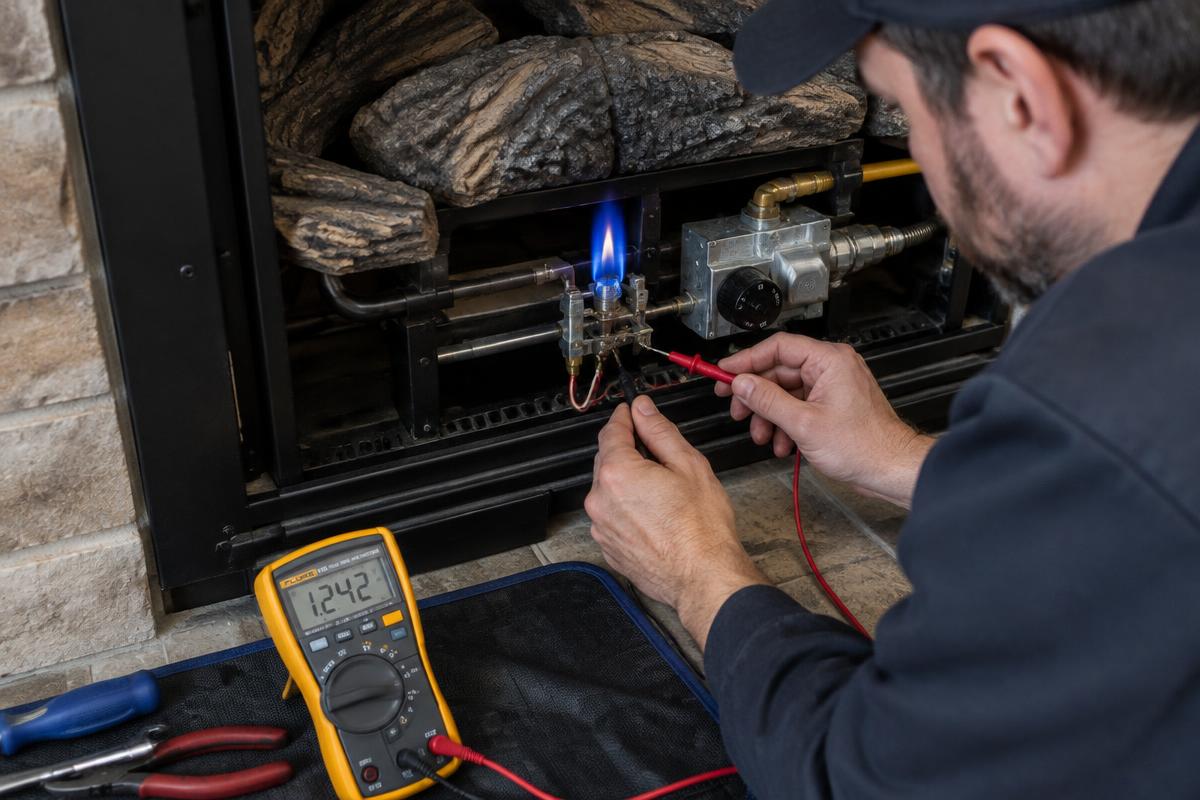
A useful appointment begins with the exact model, correct manuals and the homeowner's symptom history. The qualified professional determines the appropriate inspection and tests for the appliance, controls, combustion enclosure and venting. Depending on the finding, the work may include cleaning, checking specified component condition, investigating ignition or evaluating installation changes. It should not begin with a predetermined part replacement based solely on a brief telephone description.
Ask what was observed, which areas were inaccessible and what must happen before the appliance returns to use. Report nearby construction, changes to exterior surfaces, new exhaust equipment and any history of repeated resets. Vaughan Chimney Services is independent, not an authorized Heat & Glo dealer, manufacturer partner or warranty representative. If a warranty claim or an authorized distribution channel is involved, confirm the manufacturer's requirements separately. An independent assessment should clearly describe its own findings without suggesting manufacturer approval, guaranteed coverage or credentials that have not been established.
Use the model-specific service-parts record
Heat & Glo's manual portal includes service-parts information because compatibility depends on the appliance, not just the brand. Model suffixes, production changes, fuel and control generation can affect the correct part. A remote, ignition component, glass assembly or decorative front may resemble another version without being interchangeable. Ask for the exact replacement part number and the documentation supporting its use on your fireplace.
A documented manufacturer supersession can be valid even when the new part number differs from the original, but a seller's unsupported assurance is not equivalent. Keep the invoice and identification of installed components. Do not substitute ordinary glass, modify a barrier, combine unmatched control components or adapt vent parts because their diameters look similar. Safety-critical parts must preserve the approved appliance configuration. If a required item is obsolete, discuss the available documented repair route and the implications for continued ownership rather than accepting an improvised component as an automatic solution.
Keep records outside the fireplace cavity
Heat & Glo's owner manuals specifically warn against storing manuals inside the fireplace cavity. Keep documents in a household file instead, together with the rating-plate photograph, purchase record, installation paperwork and available permits or inspection reports. Include service findings, part numbers, fuel-conversion records and any authorized changes to the surrounding installation. Save digital copies that a new service provider can review before arriving.
Maintain access as carefully as the paperwork. A renovation that conceals a required access point can complicate diagnosis and necessary repair. Before changing trim or building cabinetry, establish which openings must remain available under the installation instructions. If the home's previous records are missing, identify that gap and arrange an appropriate assessment rather than creating an assumed history. When the property changes hands, pass along actual reports and outstanding recommendations. Clear records help the next owner distinguish a completed repair from a symptom that was merely discussed or temporarily absent.
Compare complete scopes rather than isolated components
Repair is often worth considering when the appliance and installation are sound, the fault is well defined and approved components remain available. A failed remote or other service item does not alone establish that the whole fireplace should be replaced. The balance changes with significant deterioration, damaged combustion enclosure, unresolved venting concerns or unavailable critical parts. Ask which findings make repair appropriate or limit its value.
A replacement Heat & Glo fireplace may need different venting, framing, finishing, electrical provisions, gas arrangements or heat-management details. The existing opening and vent cannot be assumed compatible simply because the replacement carries the same brand. Consider access for future service, the desired control system and how the room will actually be used. Compare the complete installed project with the documented repair option. Avoid promises based on a generic lifespan, advertised heating area or the appearance of an appliance in another home; the condition and requirements of your installation determine the practical choice.
Use seasonal checks to prevent forgotten problems
Before autumn use in Vaughan, review unresolved service notes, clear stored objects from the appliance area and inspect the required protective front for visible damage. Maintain smoke and CO alarms according to their instructions. Arrange overdue service before relying on the fireplace during colder weather. If the unit has been unused for a long time, or if renovation affected its enclosure or termination, have those circumstances considered before normal use resumes.
During winter, observe accessible exterior vent conditions from ground level after heavy snow or drifting. Do not cover a termination to reduce cold air, add an improvised screen or climb onto a roof to investigate. In spring, document any developing ignition, control or deposit issue while it is still fresh in memory. Follow the exact manual for seasonal settings and backup-battery care. A deliberate routine should reduce uncertainty, not become a universal startup ritual copied from a different model or an online video that happens to show a similar remote.