
Know your appliance
Kozy Heat insert service is not simply a question of whether the flames turn on. The appliance, its approved intake and exhaust system, its existing fireplace setting and its control package work together. The Chaska 335S and Nordik 34i provide useful examples because both are documented direct-vent gas inserts, yet they are not interchangeable products. This guide follows the owner’s experience from first identification through symptom recording, qualified diagnosis and repair decisions. Vaughan Chimney Services is independent, not an authorized Kozy Heat representative. Owners should remain outside the sealed combustion system, while appropriately qualified professionals handle gas work, internal servicing and technical adjustments.
Distinguish a Chaska 335S from a Nordik 34i
The Chaska 335S manual identifies model CSK-335S as a direct-vent gas fireplace insert. The Nordik 34i manual identifies model NDK-34-i as a direct-vent gas fireplace insert and describes its EVO Elevated Burner design. Those exact designations matter more than a casual description such as Kozy Heat insert. The two manuals address different products, and the Nordik documentation also identifies revision and starting-serial information. Do not assume that a newer-looking front means the appliance has the newest control system or that every manual carrying the same family name applies.
Gather the safely accessible model, serial number and fuel information, together with installation documents and controller instructions. If a label cannot be read without removing an insert surround or entering the appliance, let the professional identify it. A useful photograph shows the whole visible installation and controller, not just the flames. For service in Vaughan, explain that the appliance is an insert in an existing fireplace and describe any known chimney or liner work. This establishes the correct starting point for diagnosis and prevents an unrelated fireplace manual from driving parts selection.
Follow the insert’s air and exhaust route beyond the firebox
A direct-vent gas insert is not an open wood fire with a gas burner added. Its approved vent system brings combustion air to the appliance and carries exhaust outside through the specified arrangement. In an insert installation, the existing chimney provides a route and installation setting, but the insert still needs the exact components and connections required by its manual. The decorative surround does not establish that the concealed liner system is correctly connected, undamaged or suitable for a replacement appliance.
Tell the service provider about previous roof work, chimney repairs, water entry, animal activity or any occasion when the insert was moved. These details can be more relevant than the apparent age of the remote control. Do not pull the insert forward, disconnect a liner or investigate the chimney from the roof. A professional assessment should consider the host fireplace and vent termination alongside the appliance itself. When symptoms began after exterior work, that timing deserves investigation rather than an assumption that a coincidental electronic failure is responsible.
First decide whether the complaint begins at the control
Describe exactly what happens when you use the approved controller. Does the display respond while the appliance remains silent? Is there ignition activity without a sustained flame? Does the burner operate but fail to maintain the requested room condition? These are separate complaints. Thermostat mode, manual mode, the controller’s location and its documented settings can influence the owner’s experience without indicating a failed burner. Check only the user functions described for the installed system, such as accessible remote batteries or the selected operating mode.
Avoid repeated resets or experiments with internal switches. They can obscure the original pattern and may encourage continued use of a faulting appliance. Record displayed messages exactly, including when they occur, rather than translating every unsuccessful start as a bad pilot. The Chaska and Nordik manuals must be matched to the actual product and control package before technical troubleshooting. Internal wiring, ignition components, gas valves and pressure measurements belong to an appropriately qualified professional. Never bypass a safety device to determine whether the fireplace will run.
Separate visible flame, room warmth and circulation
An owner can see flames and still be disappointed by room warmth, but that does not establish a gas-supply fault. Begin by describing the room, selected control mode, burner behaviour and circulation-fan response separately. Note whether the room reaches the requested condition, whether the burner cycles and whether the fan is noisy or apparently inactive. Fan operation may depend on the installed system’s settings and sequence, so use the correct instructions rather than assuming it must start the instant a flame appears.
Do not increase gas pressure, alter burner controls or add an external fan inside the appliance to obtain more heat. A qualified professional can assess whether the complaint relates to controls, circulation equipment, appliance condition, installation or expectations for the space. If heating requirements have changed because of a renovation or a different room layout, say so. Repairing a failed fan and selecting a different appliance are different decisions. Neither should be justified by a visual comparison with flames in a showroom or by an unsupported promise that a particular insert will heat every part of the home.
Treat the Nordik’s flame arrangement as an engineered assembly
Kozy Heat identifies the Nordik 34i with its EVO Elevated Burner design. That product-specific arrangement is a reason to use the Nordik manual, not a reason to adjust the fire by eye. Logs, media and burner components must be the approved items in their prescribed positions. If the flame appearance changes, note whether the change followed servicing, cleaning or another event. Persistent soot, displaced decorative components or unusual flame contact warrants professional inspection rather than a cosmetic rearrangement.
Do not add embers, stones, aftermarket logs or material from another Kozy Heat model. Do not open sealed gas glass to compare the arrangement with a photograph. A professional should examine component condition and placement alongside the vent and fuel system before attributing deposits to one cause. Owners may photograph the view through intact glass during otherwise normal, safe operation, but should not restart a suspect appliance to obtain evidence. Damaged or unsecured glass means no operation until it has been professionally assessed and correctly restored.
Describe deposits and odours without assuming they are harmless
A mark on the viewing glass is evidence to describe, not a complete diagnosis. Note whether it is a light film, persistent black deposit or a change accompanied by abnormal flames. Also distinguish moisture visible briefly during a normal startup from staining or water appearing around the insert, surround or hearth. Water entry may involve the chimney or roof setting rather than the burner itself. The timing, location and associated symptoms are more useful than a guess that every mark requires a replacement glass panel.
Do not use abrasive products on the glass or release the sealed assembly for cleaning. Interior cleaning and the inspection needed before resealing belong to an appropriately qualified professional. New or unexplained odours also deserve careful treatment; do not assume that a previously used appliance is merely curing again. If gas is smelled, leave immediately without operating switches or using a phone indoors, then contact the gas supplier or emergency services from outside. If a CO alarm sounds, leave and call emergency services from outside rather than investigating the insert.
Give housekeeping and technical maintenance separate jobs
Owner care should preserve a clear, clean environment around a cold appliance. Keep combustible storage, furnishings and household sprays away from the installation. Follow the applicable manual for permitted exterior cleaning and controller care. Keep the required protective barrier installed, and remember that it does not make the glass safe to touch. Do not push a vacuum nozzle into the appliance, spray cleaner through openings or remove covers merely because dust is visible behind them.
Technical maintenance should assess function as well as appearance. Depending on the exact model and installed equipment, a qualified professional may inspect burner and pilot condition, media, glass sealing, electrical connections, circulation equipment and the vent system. For an insert, accessible liner connections and the chimney termination are part of the broader picture. Request findings that distinguish routine cleaning from defects requiring repair. A service record should also identify unresolved concerns or operating restrictions. An insert that looks clean can still be incorrectly vented, while a dirty-looking surface alone does not explain every control failure.
Use the operating sequence to guide professional diagnosis
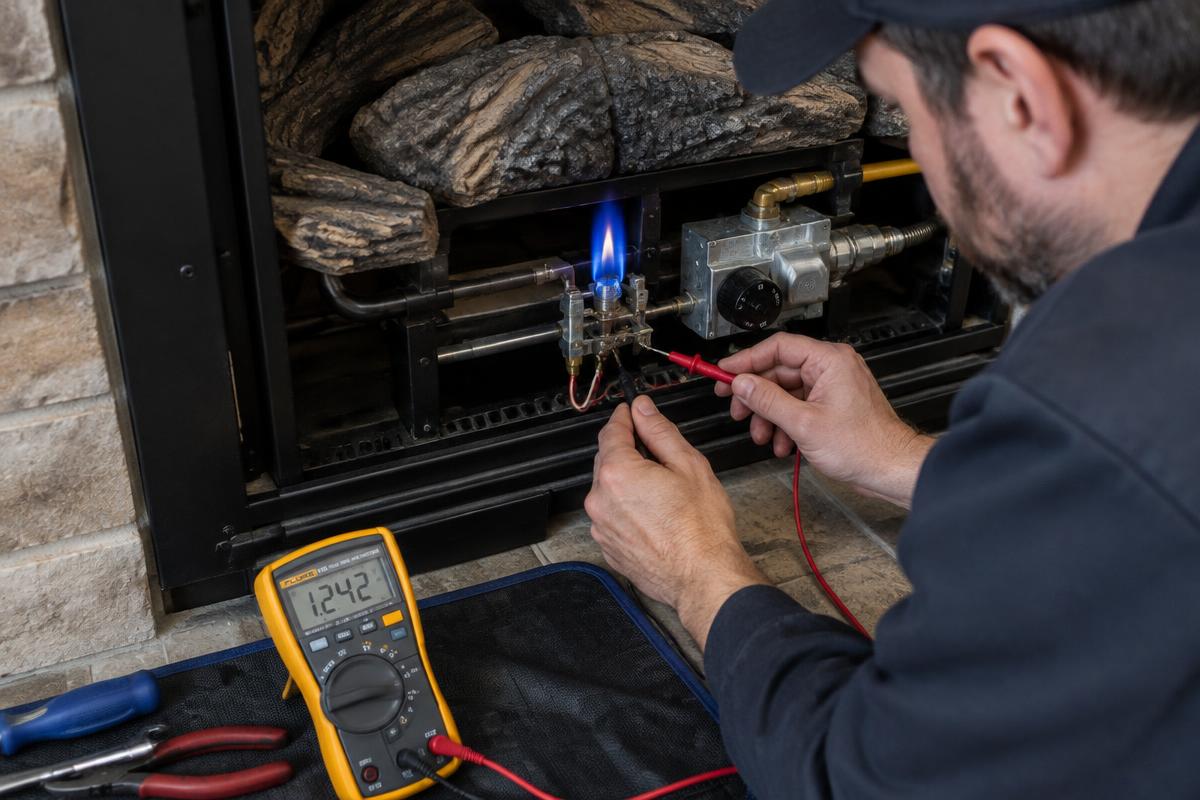
A qualified diagnosis follows what the appliance is trying to do and where that sequence stops. Depending on the symptom, the professional may assess the user-command path, power supply, ignition system, flame sensing, burner operation and fuel supply, while checking that the vent configuration is suitable. Gas-pressure testing and adjustment are professional tasks. A failure to establish flame is not permission for an owner to clean an orifice, alter a pilot or test the fireplace with its sealed glass removed.
Ask for an explanation linking the proposed repair to the observed fault. If a module is suspected, were its supply and connected components considered? If venting is implicated, what installation evidence supports that conclusion? The purpose is not to direct the technician’s work but to understand whether the recommendation addresses the cause or only a symptom. If the issue remains intermittent, a clear record of uncertainty is preferable to an unsupported assurance. No safety device should be bypassed, and no recurring shutdown should be dismissed simply because the appliance eventually restarts.
Use model and serial applicability when matching parts
The Nordik 34i manual includes revision and starting-serial information, illustrating why a product name alone can be insufficient for service decisions. Match replacement glass, gaskets, logs, burners, fans and control components using the complete appliance information and the applicable manufacturer documentation. Chaska 335S parts should not be assumed suitable for a Nordik 34i. Fuel type also matters: use only the gas indicated on the rating plate unless a permitted conversion is completed with the correct kit by an appropriately qualified professional.
A part that physically fits may still be wrong for the appliance’s intended operation. Ask whether the proposed component is identified for the exact version and whether any associated parts or procedures are required. Avoid second-hand controls with uncertain identification, improvised glass substitutions and generic decorative media. If a necessary component cannot be properly matched or sourced, that limitation belongs in the repair-versus-replacement discussion. It should not be hidden by installing an approximate substitute or changing the operating sequence to make incompatible equipment appear functional.
Prepare the fireplace opening for an assessment, not a DIY removal
A Chaska or Nordik insert can appear to be a single appliance in a simple opening, but the surrounding fireplace remains important to service access. A deep hearth, fitted surround, nearby cabinetry or delicate stone can affect how inspection is organized. Before an appointment, provide a room photograph showing the complete opening and explain any finish that cannot be moved casually. Make manuals and previous liner or chimney documents available. Let the insert cool completely and clear furniture from the working area, but leave the appliance, surround and liner connections in place for professional handling.
Discuss the scope before work starts. Routine cleaning, investigation of an intermittent fault and removal for concealed vent inspection are different activities. If the technician cannot examine a connection without additional access, ask for that limitation and the recommended next step in writing. Do not interpret an unobstructed view of the firebox as a complete inspection of the chimney route. Similarly, repainting or replacing the surround should not conceal water staining before its cause has been assessed. Planning access can avoid repeated disruption, particularly when chimney repairs or roof work need to be coordinated with insert service. Keep photographs and invoices for completed work in the same record as the appliance model and serial number. During a future sale or renovation, this combined history helps distinguish an appliance repair from a change to the host fireplace, rather than leaving the next owner to guess which concealed components were actually addressed.
Make the repair decision around the whole insert installation
Repair is sensible when a specific fault is established and the insert, sealed glass system, host fireplace and venting remain serviceable. Replacement warrants consideration when structural damage, unavailable essential parts, recurring unresolved faults or substantial installation defects undermine the value of another component repair. A new insert must be assessed for the actual fireplace opening, approved vent arrangement and finishing requirements. Existing liners and surrounds are not automatically reusable simply because the new appliance is another Kozy Heat product.
For a Vaughan property, assemble a decision record covering the diagnosed defect, proposed work, remaining condition concerns and any separate chimney or vent work. Vaughan Chimney Services is independent and is not an authorized Kozy Heat representative; confirm gas-work qualifications and direct manufacturer authorization or warranty questions through Kozy Heat’s documented channels. Keep manuals and service records outside the hot appliance cavity. Maintain smoke and CO alarms as instructed, and never treat their silence as proof that an unresolved appliance fault is safe. The goal is a supportable installation, not simply a fire that can be made to light.