
Know your appliance
An Urbana fireplace's broad viewing area can make the flame presentation seem like the whole appliance, but safe ownership depends on less visible details: its exact model, fuel, venting, controls and approved interior configuration. Official Urbana documents distinguish owner operation from installation work and identify multiple model families and revisions. This guide explains how to gather that information, recognize symptoms and plan professional maintenance without attempting gas repairs or opening sealed glass. Vaughan Chimney Services is an independent service business, not an authorized Urbana dealer. Manufacturer documentation and the assessment of appropriately qualified personnel must determine compatibility, service methods and installation decisions.
Locate Your Urbana Within the Correct Manual Generation
Urbana's official manual selector includes current and legacy documentation across several model families. Start with the complete rating-plate designation, serial number and fuel, not merely the approximate width of the viewing window. The cited installation manual explicitly distinguishes U50, U70, U50T and U70T designations. Preserve every suffix when requesting service or parts. A shared number or a similar front view is not enough to establish that two appliances have identical installation requirements or internal components.
Use accessible paperwork and ordinary owner access to obtain identification. Do not remove sealed glass, trim requiring unfamiliar disassembly or hot components to reach a label. Ask a professional to photograph it during service if necessary. Assemble the owner manual, applicable installation manual and any separate media or accessory instructions. Where the manual number or revision differs between documents, have applicability checked rather than choosing whichever is easiest to download. Record photographs of the full installation as well as the controls, since surrounding finish, ventilation openings and service access can matter even when the appliance designation is already known.
Use the Rating Plate as the Fuel Authority
The cited Urbana U30-U50-U70 owner manual and U50/U70 installation manual state that the appliance is for the gas type indicated on its rating plate and is not convertible for use with other gases. Treat that language as a firm boundary for the models and document revisions concerned. Do not assume that a conversion approach used by another brand, or even a different Urbana product, applies here. Any uncertainty about the installed fuel or previous work requires qualified verification before operation.
Owners should not inspect fuel suitability by changing regulator settings, adjusting pressure or replacing burner components. Those are gas-service matters requiring appropriately qualified personnel and applicable documentation. Supply the technician with records of property fuel changes, appliance replacement or previous gas work. If the paperwork conflicts with the identification label, stop and resolve the discrepancy. A familiar flame appearance is not proof that the fuel configuration is correct. Similarly, an invoice using a shortened model name cannot override the actual appliance label. Accurate identification prevents a maintenance request from turning into an unsafe experiment with an incompatible gas arrangement.
Inspect the Installation Context, Not Just the Firebox
The vent system, combustion-air route and surrounding construction are part of the fireplace installation. A professional assessment should verify them against the specific Urbana manual, including permitted components and termination conditions. An exterior outlet that appears intact does not reveal concealed joints or establish that the full route is suitable. Gather installation photographs, plans and previous inspection reports if available. Note whether later work changed the wall finish, adjacent cabinetry, ceiling arrangement or access to components that may need service.
From a safe ground-level position, an owner can observe whether snow, vegetation, stored objects or construction appear to obstruct the termination area. Do not climb, dismantle the cap or insert tools to clear a suspected internal blockage. Keep the fireplace off when obstruction or damage is suspected and arrange qualified inspection. Changes elsewhere in the building can also be relevant, especially if the installation was altered or openings were covered during a renovation. Report those changes rather than assuming a new operational problem must originate in the burner. A useful diagnosis considers the whole installation before isolating an individual component.
Keep Decorative Media Tied to the Exact Model
Urbana's model-specific installation documentation is the starting point for approved interior arrangements. Logs, glass or other decorative media should never be treated as interchangeable simply because they can physically fit inside the viewing area. Verify the exact appliance, installed burner and relevant setup instructions before considering replacement media. A photograph of another Urbana installation can show a possible appearance, but it does not establish that the same materials or arrangement are approved for your unit.
Do not move gas logs, redistribute loose media or introduce stones, ornaments or other objects into the sealed enclosure. An arrangement can influence flame contact, ignition and the condition of nearby components. If something looks displaced or damaged, document it through the glass if safe and leave correction to qualified personnel. Ask the service provider to identify the relevant setup document and verify that the installed pieces belong to that configuration. Where a previous owner has changed the interior without records, restoring a verified arrangement is necessary before normal operation can be evaluated. Cosmetic preference should never override the manufacturer's model-specific requirements.
Describe the Sequence Behind a Fault
A useful Urbana fault report follows the sequence of operation. State whether the handset responds, whether the normal ignition process begins, whether the burner lights and when the appliance stops. Record existing display messages, unusual noises or visible deposits without repeatedly recreating the event. Include whether the change followed a power interruption, battery replacement, construction dust, severe weather or professional work. This information helps distinguish a control complaint from a broader operating problem, while leaving diagnosis to qualified personnel.
Owner checks should remain limited to normal settings and user-accessible battery procedures allowed by the correct manual. Do not remove sealed glass, adjust gas pressure, move media, bridge electrical connections or bypass a safety function. Stop operation for damaged glass, abnormal ignition, unexpected soot or recurring unexplained shutdown. If you smell gas, leave the building immediately without using switches or a phone inside. Call the gas supplier or emergency services from outside. If a carbon-monoxide alarm activates or exposure is suspected, leave immediately and obtain emergency assistance from outside; do not stay indoors looking for a fireplace fault.
Specify What Professional Maintenance Should Resolve
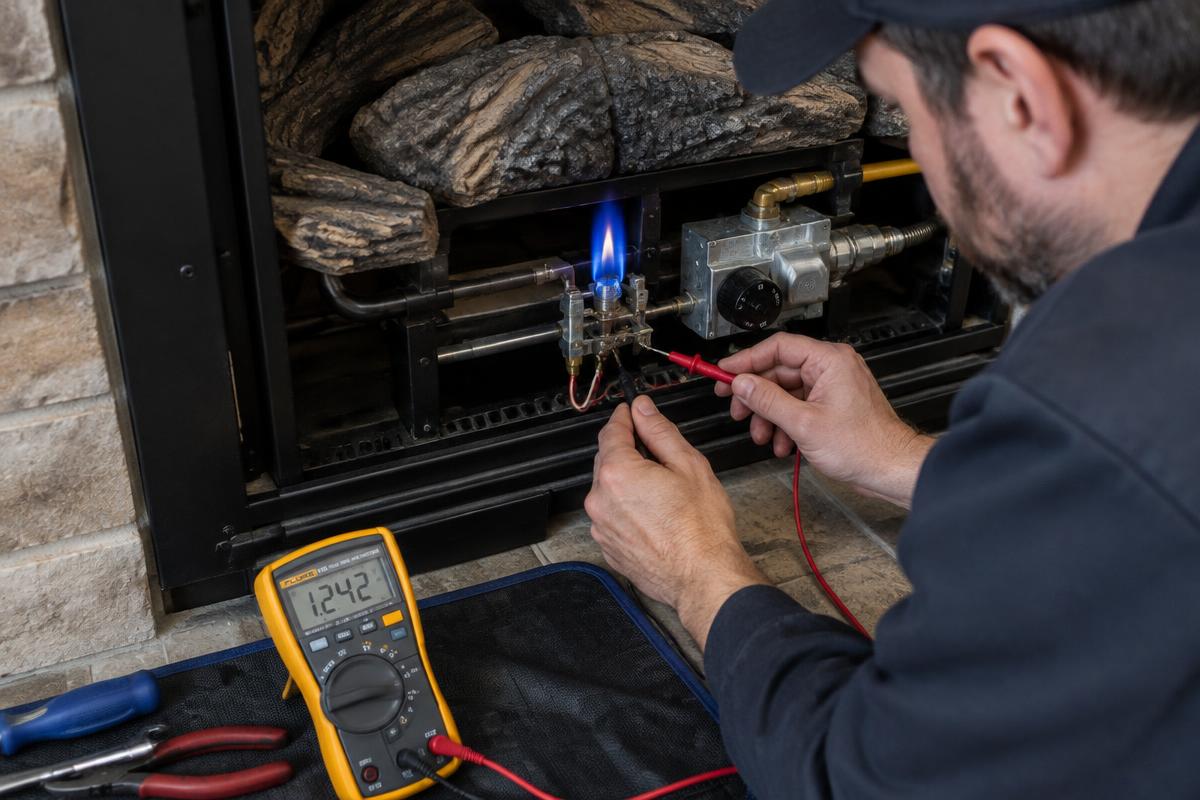
Professional maintenance should establish both condition and configuration. For the identified Urbana, the technician should consider the burner and ignition components, relevant controls, combustion enclosure, glass and seals, protective barrier and accessible venting under the applicable instructions. Gas testing and repairs must be performed by appropriately qualified personnel. Ask whether the visit is routine maintenance, fault diagnosis or both, because a standard cleaning appointment may not include all the investigation needed for an intermittent shutdown or a suspected installation issue.
Cleaning should not erase evidence before the cause of abnormal deposits is considered. Provide photographs and describe how quickly the condition developed. The report should distinguish ordinary cleaning, observed defects, proposed components and any access limitations. If a concealed area could not be assessed, the record should say so rather than imply that the entire installation was verified. Follow the manufacturer's maintenance guidance, adjusted to actual conditions and professional findings. A heavily used fireplace, an unknown service history or contamination after renovations may need attention earlier than an owner's usual seasonal routine.
Keep the Viewing Assembly and Barrier Complete
Large viewing glass demands careful handling, but its function is not merely visual. The assembly and its seals help maintain the intended combustion enclosure, while the barrier reduces the risk of contact with hot glass. Do not operate with cracked glass, a displaced frame or an uncertain seal, and do not remove a barrier to obtain a clearer view. Keep children, pets and vulnerable occupants away from the hot appliance and allow for cooling after shutdown. An intact-looking surface can remain hot even when no flame is visible.
This guide does not direct owners to remove sealed gas glass. A qualified professional should perform internal cleaning and assessment, then restore the assembly according to the exact model instructions. Replacement glass, retainers and gaskets need verified compatibility; household glazing, generic sealant or an approximate gasket size is not sufficient. Tell the technician whether deposits appear as a light film, localized darkening or rapidly accumulating soot, but do not diagnose the cause by appearance alone. A damaged barrier also needs the correct replacement rather than an improvised screen that changes access or airflow.
Link Controls and Replacement Parts to the Installed Revision
A remote that looks familiar may not establish the identity of the installed control system. Record handset markings, available receiver information from paperwork and any history of control replacement. Owner actions should remain within the operating manual, including only permitted battery access and normal settings. A responsive display does not prove that the fireplace's ignition or safety systems are functioning, and an unresponsive accessory does not identify a gas fault. Report exactly which function has changed rather than describing every issue as a bad remote.
For replacement parts, require a match to the complete model, serial information, fuel and manual revision. Ask for the proposed part number and confirmation of any supersession. This applies to controls, valves, ignition assemblies, glass, gaskets, barriers and decorative packages. A component sold for Urbana generally, or shared with another product family, still needs specific verification. Do not authorize improvised wiring, substituted gas components or safety bypasses while waiting for parts. Keep the appliance out of service when a safety-critical component is unresolved, and retain invoices and installed-component records so the next technician does not have to reconstruct the repair history.
Prepare the Fireplace Before Cold Weather Arrives
Seasonal preparation begins with the last report, not the first ignition attempt. Resolve outstanding recommendations, maintain smoke and carbon-monoxide alarms and clear stored materials from required appliance spaces. Check the owner manual for normal control preparation and shutdown guidance. Do not assume every pilot or control arrangement should be managed the same way through summer. If the fireplace was left unused because of a fault, that fault remains unresolved until it has been assessed, even if the display now appears normal.
Observe the accessible termination surroundings after snowstorms, high winds or nearby construction, but leave unsafe access and suspected blockage to professionals. Protect the installation from renovation contamination without covering operating openings or running the fireplace in an unapproved condition. After water intrusion, impact damage or significant building alterations, obtain assessment before restarting. Record new noises, odours or operating changes and avoid repeated trials during a cold-weather emergency. A fireplace should not be treated as guaranteed backup heat merely because it worked during a previous season; readiness depends on its actual condition, approved configuration and operating provisions.
Account for the Viewing Area When the Room Changes
A broad Urbana viewing window can influence where people sit and place furniture, but visual proximity should not determine combustible clearances. Follow the exact installation requirements when adding a sofa, wall-mounted equipment or decorative shelving. The protective barrier does not make close contact safe, and the warmth felt by a person is not a reliable measurement of the temperature affecting nearby materials. Have proposed finishes and access changes reviewed before installation rather than relying on how the existing room feels during a short run.
Also consider service access. A wide surround or built-in cabinet can conceal a panel that a professional needs for inspection, even though it leaves the flame view unobstructed. Retain the installation drawing and identify any intentionally provided access route. For an appointment, clear the working area, provide the owner and installation manuals and explain any restrictions before work begins. Do not remove the glass or open a finished wall in preparation. If a new interior layout coincides with a complaint, record what changed and when, so the assessment can distinguish an appliance defect from a surrounding condition that needs separate correction.
Base the Next Investment on Documented Condition
Repair is appropriate when the enclosure and vent installation are sound and the fault can be corrected with verified components. Replacement may deserve consideration when deterioration is extensive, the installation needs major correction or safety-critical parts cannot be confirmed. Ask the professional to separate established defects from possibilities requiring further investigation. A cosmetic media change is a different decision from a repair needed for safe operation. Do not let either the size of the viewing window or the appliance's apparent age substitute for a condition assessment.
A replacement proposal should address venting, fuel, electrical needs, clearances, framing, finish work and future service access. Even an apparently similar Urbana may not use the same installation provisions. Keep labels, manuals, media instructions, approvals where available, inspection findings and repair invoices in a single ownership record, and pass that file to future occupants. Vaughan Chimney Services is independent and is not an authorized Urbana dealer or manufacturer representative. Manufacturer-specific technical questions and part compatibility must be resolved through verified documentation and suitable professional channels, without implying that independent service creates factory authorization or a manufacturer-backed promise.