
Know your appliance
Town & Country ownership involves more than choosing an attractive flame presentation. The fireplace chassis, burner package, fuel, vent system and decorative components must form an approved combination. Official documentation separates installation, operation, burner and venting instructions, making accurate identification essential for both maintenance and replacement parts. This guide explains how to organize those details, recognize warning signs and prepare for qualified service without opening the sealed combustion enclosure. Vaughan Chimney Services is an independent service business, not an authorized Town & Country dealer. No manufacturer affiliation is implied, and gas work must be performed by personnel appropriately qualified for the task.
Assemble the Fireplace's Full Set of Instructions
A Town & Country installation may require several documents rather than one universal manual. The official library separates installation and operator manuals from burner and venting instructions. Begin with the complete fireplace designation and serial number, then identify the installed burner package and any special vent equipment. The TC42D2 installation manual and TC42D Version 2 operator manual are examples of documents serving different purposes for a defined appliance series. Do not assume that a manual headed TC42 automatically applies to every generation or configuration bearing that family name.
Keep the documents together with photographs of the fireplace, barrier, controls and accessible label. If the identification label cannot be reached through familiar owner access, have a professional record it without asking you to dismantle the enclosure. Preserve original paperwork even when obtaining a newer document, since revision applicability may need confirmation. When a fireplace has been remodelled, also gather invoices describing burner, trim or control changes. The resulting document set should explain what is installed now, not simply what the house originally contained. Missing information is a reason for verification, not an invitation to guess.
Set Expectations From the Appliance's Classification
The cited TC42D2 installation manual calls that model a direct-vented decorative gas appliance and states that it is not intended to be used as a heating appliance. That is a model-specific statement with practical consequences. A homeowner should not judge its condition solely by whether it heats a large room or replaces furnace output. Flame presentation, operating reliability and safe installation remain important, but an expectation unsupported by the appliance's classification can lead to unnecessary adjustments or unsuitable replacement recommendations.
Do not extend the TC42D2 description to every Town & Country product without checking its own documentation. Establish what the installed model is designed to do, which operating modes it supports and what the room actually needs. If the goal has changed from occasional ambiance to dependable space heating, discuss that goal explicitly during replacement planning. Do not seek extra heat by increasing gas pressure, altering burner openings, removing barriers or changing media. Those actions can compromise the approved configuration. A properly documented appliance can be functioning as designed while still being the wrong product for a new heating objective.
Identify the Gas Type and the Approved Vent Package
The TC42D2 instructions limit operation to the gas type indicated on the rating plate and permit conversion only through an appropriate certified kit. Natural gas and propane therefore cannot be treated as interchangeable supply choices. Record any conversion history and the documentation left by the installer. Fuel conversion, gas pressure testing, leak testing requiring service access and gas-control repairs are tasks for appropriately qualified personnel. An owner should not attempt to identify a fuel mismatch by changing adjustments or experimenting with operation.
The vent arrangement also needs its own identification. Town & Country's official manual library includes separate power-vent documentation, so the presence or absence of that equipment matters when interpreting a fault. Do not assume that every installation uses the same passive vent route or that a visible exterior outlet reveals all concealed components. Provide plans, installation photographs and accessory paperwork where available. A professional should verify permitted vent components, configuration, termination conditions and any model-specific electrical or control relationships. Renovations near a termination or changes to concealed vent access should be recorded because the installation surrounding the fireplace can affect the service assessment.
Treat Logs, Stones and Glass Media as Specified Components
Town & Country's manual library lists distinct burner instructions, including named packages for particular fireplace families. This is evidence that decorative presentation is not independent of the burner system. A log arrangement, glass treatment or other media package must be approved for the exact chassis and burner combination. Do not select an attractive media set from a different model, mix leftover pieces or infer compatibility from the width of the firebox. The applicable burner documentation determines the approved components and arrangement.
Owners should not move logs, redistribute media or add decorative objects inside the combustion enclosure. Media placement can interact with flame paths, burner openings and ignition conditions; a casual rearrangement may create more than a cosmetic change. If a piece appears broken, displaced or unusually sooted, photograph it through the glass if safe and request qualified assessment. The technician should establish the installed package before replacing or repositioning anything. Ask that the final service record identify the burner and media instructions used, especially when the fireplace has a presentation different from photographs in its original sales brochure.
Capture Ignition and Shutdown Details Without Repeated Trials
When reporting a fault, distinguish a remote-control problem from an ignition or combustion problem. Note whether the handset displays information, whether the fireplace begins its normal sequence, whether a flame appears and whether shutdown happens immediately or after operation. Record any visible message and relevant circumstances, such as a recent power interruption or service visit. Do not repeatedly cycle the appliance to obtain a recording. A consistent written timeline often gives the professional enough information to plan an inspection without creating additional ignition attempts.
Safe checks stay within the operator manual: ordinary settings, user-accessible batteries and observation of the external barrier and clearances. Do not open sealed glass, bridge control terminals, bypass a safety device or adjust gas pressure. Stop using an appliance with delayed ignition, damaged glass, new soot or unexplained repeated shutdowns until it is assessed. If gas is smelled, leave the building immediately without operating switches or using a phone inside. Contact the gas supplier or emergency services from outside. For a carbon-monoxide alarm or suspected exposure, also leave immediately and obtain emergency assistance from outside rather than investigating indoors.
Define a Service Visit Beyond a Clean Viewing Window
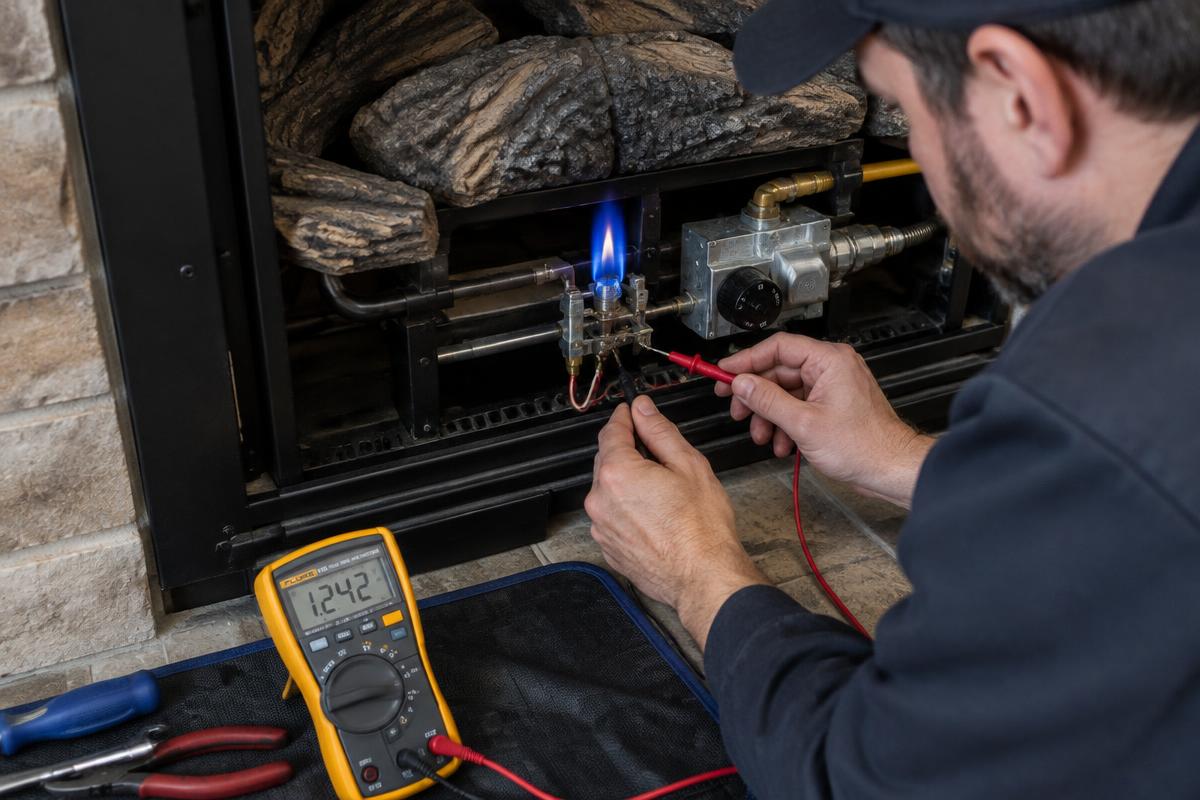
A qualified inspection should relate the observed condition to the exact Town & Country installation. Relevant areas include the combustion enclosure, glass assembly, barrier, burner and ignition components, controls and accessible vent system. Where power-vent equipment is installed, its condition and relationship to operation also need consideration under the applicable instructions. The technician should distinguish cleaning from diagnostic work and explain when additional access or testing is necessary. A fireplace can look clean from the room while still having an unresolved operational or installation problem.
Ask for written findings rather than an unsupported assurance that everything looks fine. The report should identify work completed, parts recommended, limitations and any condition requiring the appliance to remain off. Gas-system testing and adjustment must remain with appropriately qualified personnel. Cleaning should use procedures and materials suitable for the specific components, without rearranging media according to personal preference. Maintenance timing should follow manufacturer instructions and actual conditions. Unknown history, renovation dust, heavy use, abnormal deposits or recurring ignition issues can justify assessment sooner than an owner's customary pre-winter appointment.
Respect the Separate Roles of Glass, Seals and Safety Screens
The sealed viewing assembly and the external protective barrier do different jobs. A barrier helps reduce contact with hot glass, while the glass and its sealing arrangement form part of the combustion enclosure. Neither should be removed or substituted to improve appearance or heat output. If the glass is cracked, its frame appears displaced or the barrier is damaged, discontinue use and obtain assessment. Keep children and vulnerable occupants away from the appliance, including during the cooling period after shutdown.
Do not remove sealed gas glass for owner cleaning under this guide. Qualified personnel can inspect the assembly, clean appropriate surfaces and restore its retainers and seals correctly. Replacement glass must match the exact model's approved specification and assembly; ordinary glazing or a cut-to-fit approximation is not acceptable evidence of suitability. A cloudy film and a heavy dark soot deposit should not automatically receive the same explanation. Describe when the deposit appeared and whether operation changed. Cleaning that removes a symptom without investigating its cause may leave a combustion or configuration issue unresolved.
Require a Traceable Match for Every Replacement
A proposed Town & Country replacement part should be traceable to the appliance series, serial information, fuel and installed package. This matters for valves, ignition components, controls, glass, seals, burners and decorative assemblies. Similar product names or an apparently identical casting do not establish compatibility. Ask the supplier or qualified professional to provide the applicable part number and explain any replacement of an older number with a newer one. Where the documentation is incomplete, compatibility should be resolved before the item is installed.
Keep the invoice, component identification and service findings after the repair. If a previous owner fitted undocumented controls or media, the technician may need to establish an approved configuration rather than replacing like for like. Never authorize a safety bypass, improvised pilot assembly or unverified burner modification because an original item is hard to obtain. A component that physically connects may still have unsuitable operating characteristics. If verified parts are unavailable, discuss the implications openly, including whether the appliance must remain unused while a safe repair or replacement route is developed.
Prepare for Seasonal Use and Confirm Indoor or Outdoor Status
Before seasonal startup, review unresolved service recommendations, inspect accessible exterior areas from a safe position and clear stored materials from required spaces. Maintain carbon-monoxide and smoke alarms according to their instructions. Snow, ice, vegetation and construction can change termination surroundings, but owners should not climb to investigate or insert tools into a vent. A suspected obstruction requires professional attention before operation. Review normal controls before winter, and do not use repeated ignition attempts as a substitute for an inspection after an extended fault.
Location is another model-specific issue. Town & Country publishes separate instructions for a TC42 outdoor model, explicitly identifying it as for outdoor use only. That does not make an indoor TC42 suitable for exposure or an outdoor model appropriate inside a newly enclosed room. Patio enclosures, additions and changes to openings can alter the installation context. Have such changes assessed before using the fireplace. During summer shutdown, follow the exact operator instructions rather than generic advice about pilot operation. After storms, water intrusion or nearby building work, arrange reassessment if the appliance or vent may have been affected.
Preserve Access Behind the Architectural Finish
Town & Country installations can be integrated into substantial wall finishes, so service access deserves attention before a renovation is completed. The fireplace, burner package and any vent equipment may require different access provisions. A neatly finished wall does not establish that those provisions remain available. Ask a qualified installer to review cabinetry, facing and concealed panels against the actual installation documents before construction. Do not permanently cover an access point simply because it is rarely used or looks unrelated to the viewing area.
Before service, explain which areas are accessible and identify delicate materials, condominium permissions or exterior equipment requiring separate arrangements. Clear the room and let the appliance cool, but do not detach sealed glass or remove finishes yourself. Clarify whether the request concerns preventive cleaning, diagnosis or a known part replacement. If concealed components cannot be inspected during the initial visit, ask for that limitation to be recorded rather than treating them as verified. Construction photographs and the full document set can help the technician plan the next step, although they do not replace an inspection of present condition.
Compare Repair and Replacement as Complete Projects
A repair decision should begin with the condition findings, not a general rule about fireplace age. Verified replacement parts, a sound enclosure and a suitable vent installation may support a limited repair. Extensive deterioration, repeated unresolved faults or unavailable safety-critical components may favour replacement. Ask which findings are definite and which depend on further access. A recommendation should distinguish essential safety work from optional changes in appearance so that the owner can make a clear decision without confusing a new media preference with a technical necessity.
For replacement, compare the full scope: appliance purpose, vent requirements, fuel supply, electrical provisions, clearances, framing, finish repairs and access for future service. A new fireplace that fits the visible opening may still require substantial installation changes. Keep a household file containing labels, manuals, burner and vent documents, approvals where available and maintenance records. Vaughan Chimney Services is an independent business, not an authorized Town & Country dealer. Any proposed gas work must be assigned to appropriately qualified personnel, and product-specific compatibility or manufacturer support questions should be resolved through verified official information.