
Know your appliance
Marquis service questions often begin with a design name, but safe decisions require the underlying model and installed system. A Bentley 48, a Skyline ZCVRB3622 and a Capri insert do not share one universal troubleshooting procedure. Marquis documentation also includes power-vent equipment, making the actual vent arrangement especially important. This guide focuses on identifying those differences, recording symptoms safely and understanding professional recommendations without entering the gas system. Vaughan Chimney Services is independent and is not an authorized Marquis representative. Gas work, internal controls, combustion adjustments and sealed-glass access must be left to an appropriately qualified professional using the exact manufacturer instructions.
Translate the design name into an exact model
The Marquis manual archive lists separate documents for Bentley models, Skyline versions, Capri inserts, Enclave products and power-vent equipment. That range makes a description such as Marquis linear fireplace too broad for technical decisions. The Bentley 48 manual identifies MQZCV48 model variants, while the Skyline document identifies ZCVRB3622 variants. Similar trim, controls or flame presentation does not establish that those appliances share glass, burners, venting rules or replacement parts. Begin with the rating plate or reliable existing installation paperwork.
Record the complete model, serial number, gas type and controller information. Note whether the appliance is a built-in fireplace, an insert inside an existing fireplace or a different configuration. If a label is hidden, do not remove sealed glass, reach into hot spaces or dismantle finished surrounds to find it. A professional can obtain identification during safe access. Photographs of the visible installation, controller and any exterior termination visible from ground level can provide useful context, but they do not replace a model-specific inspection or establish the condition of concealed components.
Recognize the Bentley 48 as a gas fireplace, not a solid-fuel firebox
The Bentley 48 installation instructions list natural-gas and propane variants and explicitly state that the appliance is not for solid fuel. Its direct-vent installation must follow the approved component, routing and termination requirements for the exact model and fuel. The manual includes fuel-sensitive venting provisions, illustrating why an apparently minor model suffix can matter. Do not burn paper or wood inside the appliance, substitute fuel informally or borrow a vent layout from another Bentley size.
A built-in Bentley also depends on its enclosure, facing and combustible-clearance details. Renovations around the fireplace can therefore be relevant to a new complaint even if no gas component was touched. Report new shelving, trim, wall finishes, television cabinetry or exterior work near the termination. Do not remove finishes to inspect framing yourself or assume that a noncombustible-looking surface proves the construction behind it is compliant. A qualified professional should compare the actual installation with the applicable instructions and identify whether further access is needed before recommending appliance parts.
Keep Skyline versions and linear media arrangements separate
The Marquis archive distinguishes Skyline III, Skyline II, Skyline MQRB4236 and Skyline ZCVRB3622 documentation. The cited ZCV3622/ZCVRB3622 manual identifies the latter Skyline as a vented gas fireplace heater and prohibits solid fuel. Do not use a manual for a different Skyline version simply because both have a long viewing window. Linear burners and their approved media arrangements are engineered systems; appearance alone cannot establish that a decorative substitute or a different placement is acceptable.
If flames become uneven, soot appears or media looks displaced, record what changed and whether the condition followed servicing. Leave internal adjustment to an appropriately qualified professional. Do not add glass media from another appliance, redistribute material across burner openings or open sealed gas glass to compare the firebox with an online image. The professional should assess the correct media and burner arrangement alongside fuel supply and venting. A visual improvement obtained by rearranging material does not prove combustion is correct, and persistent deposits should not be dismissed as an unavoidable feature of a linear design.
Establish whether a power vent is actually installed
Marquis publishes separate manuals for power-vent equipment, including PVH58 and PVH58FM entries. Their presence in the archive does not mean every Marquis fireplace uses a power vent. Confirm the installed arrangement from documentation and professional identification. A natural-draft direct-vent system and an approved power-vent installation can present different diagnostic sequences. An exterior component that makes noise should not automatically be described as the fireplace’s circulation fan, because room-air circulation and combustion venting are different functions.
If a power-vent system is documented, note whether a new sound or operating change occurs before ignition, while the burner runs or after shutdown. Do not remove its cover, interfere with wiring, bypass an interlock or operate the fireplace while the venting equipment is disabled. A qualified professional must assess the appliance and its approved vent package together. Replacing a room-air blower cannot resolve a combustion-venting fault. Likewise, an improvised exhaust fan is not a substitute for the manufacturer-specified system, even if it moves air away from the fireplace.
Build a symptom timeline instead of naming a failed part
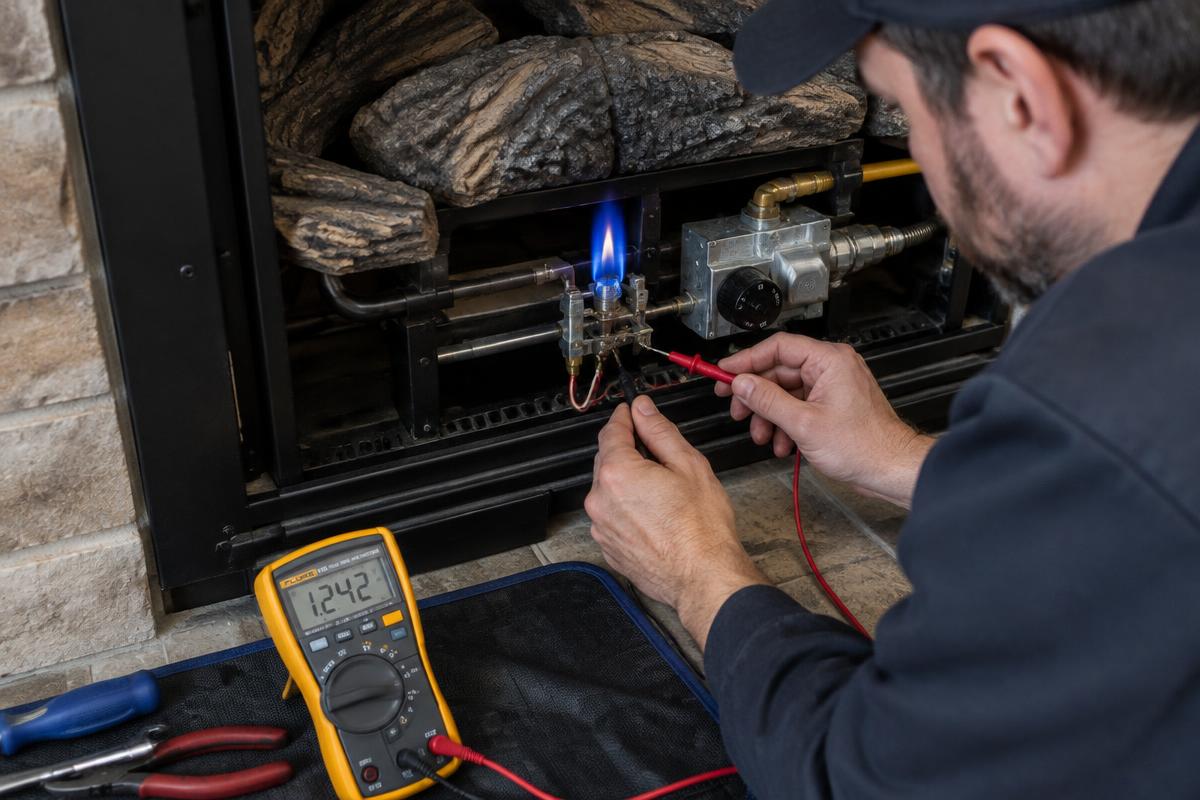
Start with the user command and describe the sequence in plain language. Does the remote respond? Is there an audible attempt to ignite? Does a flame appear briefly, remain stable or stop later? Is the complaint instead a fan noise, room-temperature issue or abnormal deposit? Record the exact controller display and whether the problem is consistent or intermittent. Distinguishing these stages helps a professional select appropriate tests without relying on an owner’s guess that every no-start condition requires a new valve.
Owner checks should be limited to documented user tasks, such as accessible remote batteries or operating modes for the installed control. Do not repeatedly reset the appliance, move internal controls, probe electrical connections or adjust gas pressure. If there is a bang, abnormal flame, persistent soot or damaged glass, stop use pending assessment. If gas is smelled, leave immediately without using switches or a phone indoors, then contact the gas supplier or emergency services from outside. If a CO alarm sounds, evacuate and seek emergency assistance from outside rather than attempting further observation.
Connect weather and renovation history to the service question
A fault that occurs only during certain wind or snow conditions deserves a different history from a remote that never responds. Record weather correlations without deliberately reproducing an unsafe event. Also report staining, water near the hearth, previous roof repairs and changes around the termination. New siding, a deck, stored materials or landscaping can alter the surroundings that the original installation depended on. These observations do not establish the cause, but they help prevent an exterior problem from being overlooked during an appliance-only repair.
Inspect only from a safe ground-level position. Do not climb onto the roof, reach into a terminal, add mesh or attach a homemade wind shield. If a termination appears damaged or obstructed, keep the appliance off and arrange appropriate inspection. The professional should identify the approved vent components and assess the route, termination and appliance together. Water evidence may also require attention beyond the gas appliance itself. Cleaning the stain or replacing an electronic component without addressing water entry can leave the conditions for a repeat failure.
Preserve the sealed glass boundary during cleaning
A Marquis gas fireplace’s sealed glass is not an ordinary cabinet door. Do not release it for cleaning, move logs or media behind it, or operate the appliance with the assembly unsecured. Interior cleaning creates a responsibility to inspect the glass, gasket and fastening arrangement and restore the seal correctly. Those tasks belong to an appropriately qualified professional following the exact manual. Cracked glass, a displaced assembly or an uncertain seal means the appliance should remain out of use.
Owner housekeeping should focus on permitted exterior surfaces when the fireplace is off and fully cool. Avoid abrasive cleaners, sprays into openings and tools pushed behind barriers. Keep the required protective screen or barrier correctly installed; it reduces contact risk but does not make the viewing area cool. Describe whether deposits are light film, persistent black soot or associated with flame changes. The professional should investigate the reason for abnormal deposits rather than simply polish the glass. A clean view is not proof that burner placement, fuel supply and venting are correct.
Expect professional diagnosis to include the connected systems
Depending on the exact model and complaint, qualified diagnosis may cover command inputs, electrical supply, ignition, flame sensing, burner condition, gas supply and vent configuration. Where approved power-vent equipment is installed, its operation and associated controls also belong in the assessment. Gas-pressure measurements, adjustments, fuel conversion and internal control work are professional tasks. The goal is to locate the fault in the system, not to install a sequence of guessed parts until the appliance happens to run.
Ask what evidence supports the recommended repair and what conditions remain uncertain. If a module is suspected, were its power and connected components considered? If a venting problem is identified, which observed installation condition requires correction? A useful service record separates confirmed defects from possible causes and states whether operation should remain suspended. No recommendation should rely on bypassing a safety switch, running without sealed glass or disabling power-vent functions. Intermittent success is not sufficient evidence that a recurring shutdown has been resolved.
Match components by model, fuel and installed control package
The Bentley 48 manual lists multiple MQZCV48 variants, and the Skyline document likewise lists fuel and control-related model variations. Use the complete designation and applicable parts documentation when matching valves, pilots, burners, glass, gaskets, fans and controls. A shared remote appearance does not prove that two fireplaces use interchangeable receivers or modules. Nor does shared manufacturer lineage make a component appropriate across every Marquis or related-brand appliance. Identification must be established before installation rather than inferred after a part looks like a fit.
Approved fuel conversion, where permitted, requires the correct kit and qualified professional work. It is not a homeowner adjustment or a change accomplished by substituting one unverified component. Decorative media and logs also require exact matching because their position and form affect operation. If a required component is unavailable, ask for that limitation to be documented rather than accepting an approximate replacement. The parts decision should preserve the manufacturer-intended configuration, including any associated settings or procedures that only the qualified professional should perform.
Plan access before the fireplace becomes part of permanent cabinetry
A Marquis installation often forms part of a larger interior design, making access planning a practical maintenance issue. A long stone face, recessed cabinet or fitted surround may conceal the route to an appliance control or another serviceable component. Power-vent equipment, where actually installed, can introduce separate access needs outside the room. Before finishing a renovation, have the proposed construction reviewed against the exact fireplace and accessory documents. Keep identified service openings accessible rather than assuming that every future repair can be completed through the viewing window. Photographs of construction before it is enclosed can be useful background for later assessment.
When requesting service, describe the complete installation and access restrictions. Mention delicate surfaces, a concealed panel, condominium access arrangements or an exterior component that cannot be reached from ground level. Do not open finished walls, detach glass or remove a vent cover to prepare for the appointment. Ask which inspection can be performed through existing access and what remains unverified if further work is needed. That distinction is important when comparing a cleaning request with a diagnostic visit or a repair involving remote vent equipment. A technician should not have to treat inaccessible components as proven sound simply because the flame eventually starts. If additional construction access is recommended, establish its purpose and how the installation will be restored before proceeding. Retain the resulting findings alongside the model and accessory manuals, so a subsequent interior update does not inadvertently block a route that was deliberately provided for safe service.
Choose repair or replacement with the installation in view
A focused repair is appropriate when the failure is established and the firebox, sealed glass system, controls and venting remain supportable. Replacement deserves consideration where major damage, unavailable essential parts, repeated unresolved failures or substantial installation defects make another repair uncertain. For a built-in Marquis, include enclosure, facing and vent-routing implications in the comparison. For an insert, consider the host fireplace and liners. A new appliance cannot be assumed to fit the existing finish or reuse every concealed component simply because its viewing size is similar.
In Vaughan, prepare a comparison that identifies the diagnosed defect, proposed repair, remaining concerns and any separate construction or vent work. Vaughan Chimney Services is independent and is not an authorized Marquis representative; verify qualifications for gas work and confirm manufacturer authorization or warranty questions through official channels. Retain the correct manuals and service records outside hot cavities, and maintain smoke and CO alarms according to their instructions. The objective is not merely restoring a flame. It is achieving a documented, maintainable installation without safety bypasses, uncertain parts or unresolved combustion symptoms.