
Know your appliance
Majestic owners can be discussing fundamentally different appliances when they report a fireplace problem. A Ruby is a direct-vent gas insert with a sealed combustion arrangement; a Biltmore is an open wood-burning fireplace with its own chimney and operating requirements. Some Biltmore installations may include an approved gas-log arrangement, which introduces another set of instructions rather than turning the fireplace into a Ruby. This guide keeps those distinctions central to observation, maintenance and repair decisions. Vaughan Chimney Services is independent, not an authorized Majestic representative. Gas work requires an appropriately qualified professional, and wood operation must follow the exact appliance manual rather than general fireplace rules.
Identify whether you have a Ruby, a Biltmore or a gas-log installation
Majestic identifies the Ruby series as direct-vent gas fireplace inserts and the Biltmore as open wood fireplaces. The Biltmore product page also notes gas-log options, but that does not mean every Biltmore contains the same gas equipment or permits every log set. Establish the fireplace model, any separately installed gas-log model, fuel and available documentation. A glass front, decorative doors or realistic logs alone cannot determine whether the appliance is a sealed gas insert, an open wood fireplace or a gas-log installation.
Majestic’s official manual search accepts a model number or name and provides installation, owner and service-parts documents. Use it to locate the exact equipment rather than selecting instructions from appearance. For a Ruby, retain the complete designation, such as the listed RUBY25IN or RUBY25IL variants, along with serial information. For a Biltmore, identify the actual size and model, plus any accessories. If identification requires removing hot parts, opening sealed glass or accessing a concealed gas control, leave that task to a qualified professional.
Understand the Ruby as a complete gas-insert system
The Ruby is an insert installed in an eligible existing fireplace using the vent arrangement prescribed by its installation manual. Its direct-vent technology separates its combustion-air and exhaust functions from the room-facing appearance. The existing fireplace and chimney still matter as the installation setting and route for the specified vent components. A fitted surround can hide the connections, but it cannot establish that they are correct or in good condition. Do not assume the original wood-fire chimney cap serves as the proper insert termination.
Report any history of water entry, roof work, chimney repairs or moving the insert. A professional may need to assess the host fireplace, vent connections and termination as well as the gas appliance. Do not pull a Ruby forward or remove its surround to investigate. A new insert proposed as a replacement also needs its own fit and venting assessment; existing components are not automatically transferable. For Vaughan owners, keeping the original installation documents can make this evaluation more reliable than relying on recollections about what was installed years earlier.
Separate IntelliFire Touch commands from combustion faults
Majestic’s Ruby product information identifies IntelliFire Touch control options and a battery-backup feature. The exact installed controller and owner instructions determine what the user can check. Record whether the control accepts a command, whether ignition activity occurs and whether a flame is established and sustained. A display that responds does not prove the entire appliance has power, while a burner that cycles is often responding to its operating mode rather than failing. Note messages exactly and avoid translating every unsuccessful start into a pilot problem.
Only perform user procedures expressly permitted by the applicable instructions, such as checking accessible controller batteries or settings. Do not enter internal controls, alter wiring, adjust gas pressure or repeatedly reset an unsuccessful sequence. Battery backup is not a promise that every accessory, particularly electrically powered circulation equipment, will function during an outage; check the exact owner documentation. An appropriately qualified professional should assess ignition, sensing, supply and control faults. No test should involve bypassing a safety device or operating a Ruby with its sealed glass removed or unsecured.
Treat a Biltmore wood fire as an open-hearth installation
Majestic describes the Biltmore as an open wood fireplace that provides radiant warmth without requiring a fan. It should not be operated or assessed like a sealed catalytic wood stove. Fuel, fire-building, damper use, screen or door positions and ash handling must follow the exact Biltmore owner instructions and any approved accessory instructions. Do not import clearance, draft or temperature figures from another fireplace. The fireplace opening, listed chimney and surrounding construction form a system whose installation requirements remain important even when the fire appears ordinary.
Before use, confirm that the correct operating documentation is available and that required inspection or cleaning has been addressed. Keep furniture, stored wood and decorations outside the manual’s required areas rather than judging distance by comfort. Burn only permitted fuel; rubbish and treated timber are not alternatives. Do not use flammable liquids to start or revive a fire. If the correct manual cannot be matched to the appliance or a previous alteration is unexplained, obtain professional assessment before resuming use rather than relying on a generic open-fire checklist.
Describe Biltmore smoke spillage by when it happens
For an open wood fireplace, distinguish smoke during a cold start from smoke after the fire is established, during refuelling or near the end of a burn. Record whether the complaint correlates with a kitchen exhaust fan, particular weather, recently changed windows or a new batch of wood. Those details help a professional consider fuel, operating practices, chimney condition and the house’s air conditions together. A smoky fireplace is not automatically evidence that the chimney is too short or that a larger cap will solve the problem.
Do not keep burning to test a theory, make structural changes or install improvised draft devices. Persistent indoor smoke warrants stopping use and arranging assessment. A suspected chimney fire requires emergency help, not an attempt to clean the flue while it is hot. If a carbon monoxide alarm activates, leave immediately and call emergency services from outside. The professional investigation may need to inspect the listed chimney system and fireplace components as well as evaluate how the home operates. A sweep alone is necessary without being sufficient to explain every smoke complaint.
Do not apply Ruby instructions to a Biltmore gas-log set
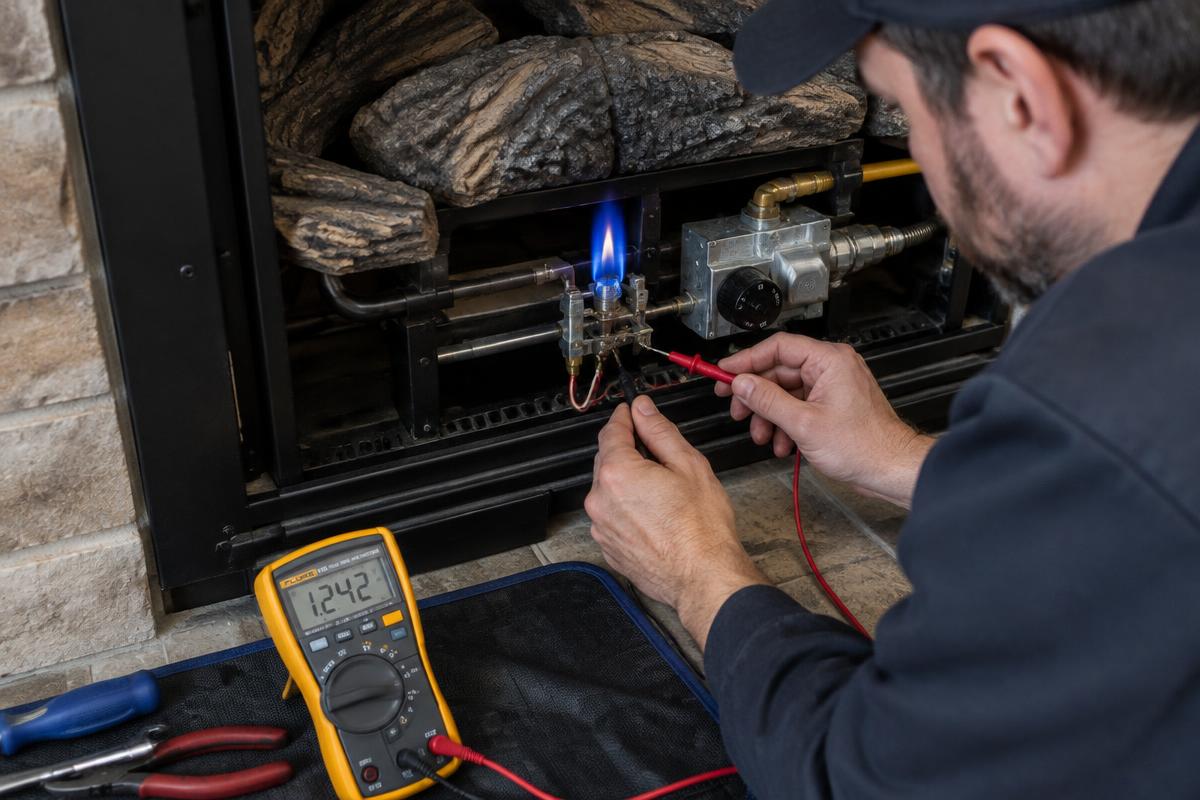
The availability of gas-log options for Biltmore does not erase the distinction between an open fireplace with a specified gas-log appliance and a sealed direct-vent insert. The log set has its own identification, fuel, burner arrangement and instructions, while the host fireplace and chimney retain their own requirements. Whether a particular gas-log installation is permitted must be established from the applicable documents and local requirements. Do not assume a product shown on a manufacturer page is suitable for every existing fireplace or jurisdiction.
A professional should verify the exact arrangement before servicing or changing it. Owners should not alter dampers, burner placement, gas controls or log positions using advice written for a Ruby. Nor should they add doors or attempt to seal an open gas-log fire to imitate a direct-vent appliance. If a gas smell occurs, leave without operating switches or using a phone indoors and contact the gas supplier or emergency services from outside. All gas diagnosis, conversion and repairs require an appropriately qualified professional, even when the burner appears simple and accessible.
Use different cleaning plans for wood and sealed gas equipment
A Biltmore wood installation needs cleaning and inspection appropriate to its fireplace and listed chimney. Follow the exact manual for ash removal, refractory care and permitted access. Ash can contain live embers long after flames disappear, so observe the manual’s disposal precautions and keep removed material away from combustibles. Do not treat a household vacuum as an ash-removal tool or scrub refractory surfaces with an improvised chemical method. Report damaged interior panels, loose components, water staining and unusual debris rather than simply clearing them away.
A Ruby requires a different boundary. Owners may maintain permitted exterior surfaces when the appliance is off and cool, but should not open sealed gas glass for internal cleaning. A qualified professional should handle interior access, inspect sealing and restore the assembly correctly. Keep its required protective barrier installed and remember that hot glass remains a burn hazard. In either appliance category, cleaning should lead to condition findings. Ask whether the connected chimney or vent, appliance components and installation were assessed, not just whether the visible firebox now looks cleaner.
Ask for diagnosis appropriate to the fuel and appliance
For a Ruby, professional diagnosis can include the command path, electrical supply, ignition and flame sensing, burner configuration, gas supply and approved vent arrangement. Gas-pressure testing and control adjustments are not owner tasks. For a Biltmore wood installation, investigation instead centres on the fireplace, chimney, fuel, operation and building conditions. If a gas-log set is present, its separate burner and control documentation must also be considered. A useful service recommendation makes clear which system was examined and which concerns remain outside that assessment.
Request an explanation connecting the symptom to the proposed work. A damaged component may require replacement without explaining every performance complaint, and an intermittent control fault may coexist with a separate venting defect. Written findings should distinguish confirmed defects, suspected causes and any need to keep the appliance out of service. Do not accept a safety bypass or advice to ignore an alarm as a diagnostic shortcut. When access to concealed construction is necessary, the reason should be explained rather than assuming the decorative finish proves the installation is acceptable.
Match parts without crossing appliance categories
Majestic’s official support page directs owners to model-specific installation, owner and service-parts documents. Use those resources with the full model and serial information. Ruby glass, gaskets, controls, burners and decorative components must match the applicable insert version and fuel. Biltmore refractory components, doors and chimney-related parts require their own identification. A panel or glass piece that appears to fit is not automatically a suitable replacement, and a generic accessory should not be assumed approved because it is advertised for fireplaces generally.
Professional installation matters as much as selection where gas or critical sealing is involved. Do not order an approximate valve, substitute ordinary glass or rearrange a burner around an incompatible part. For a wood fireplace, changes to listed chimney components or the firebox should be assessed against the exact documentation rather than improvised on site. If a necessary part cannot be correctly identified or sourced, record that limitation openly. It may affect the repair decision, but it does not justify modifying safety functions or combining parts from unrelated Majestic product families.
Review doors, screens and finishing changes before using them
The operating position of a fireplace door or screen must come from the instructions for the actual Majestic appliance and approved accessory. An open Biltmore fireplace and a sealed Ruby insert have different boundaries. A decorative glass-door set on an open fireplace is not equivalent to the Ruby's combustion glass. Do not add a door assembly, remove a screen or change an operating position based on how another fireplace looks. Ask for the accessory identification and its applicable instructions when records are missing. This is especially important after buying a home where the original owner may have changed the front without passing along the paperwork.
Room updates also warrant a review. A new mantel, flooring material, television enclosure or holiday decoration can introduce combustible material or restrict an opening that previously remained clear. Check the actual model's requirements before finalizing the layout instead of testing suitability by touching the surface during a fire. For an open wood fireplace, keep fuel storage and ash-handling arrangements separate from the fire opening and required clearances. For a gas insert, preserve the protective barrier and documented service access. If a renovation changes the chimney, roof or exterior termination surroundings, report it even when no fireplace part was replaced. Keep installation and accessory records together so later inspections can consider the appliance as installed, rather than only its original product specification. When an accessory cannot be identified or its approval remains uncertain, have the situation assessed before relying on it during operation.
Compare repair, conversion and replacement as separate projects
A Ruby repair, a Biltmore repair and a proposed change from wood to gas are three different projects. A targeted repair can be reasonable when the defect is established and the remaining installation is sound. Replacement or a change of appliance may deserve consideration when essential parts are unavailable, major damage exists or the owner’s operating needs have changed. A conversion proposal must identify the actual new appliance or gas-log system and demonstrate that the host fireplace and vent arrangement are suitable.
For a Vaughan home, compare the whole scope: appliance work, chimney or vent work, required construction changes and the condition of components proposed for reuse. Avoid deciding from age alone or from a product-only advertisement. Vaughan Chimney Services is independent and is not an authorized Majestic representative; manufacturer authorization and warranty matters should be confirmed through documented manufacturer channels. Retain the diagnosis, selected parts and final operating instructions outside hot cavities. Maintain smoke and CO alarms, but never use their silence as permission to continue operating equipment with unresolved smoke, soot, glass or ignition problems.